
With my teenage daughter getting into college within a year, the day is near when there will be demand for a two-wheeler. In urban settings, two-wheelers are the most fuel efficient, maneuverable, economical and thrilling mode of transport. But being a parent the one thing that worry us is the safety and security aspect of two-wheelers – truth be told, two-wheelers happens to be the most riskiest mode of transport. There are stats to back the concern, in India alone 44% of all fatalities on roads are two-wheeler riders, and as per Ministry of Road Transport data more than INR 90 lakh per person can be saved by preventing deaths and reducing injuries, 3 to 5% GDP (India) every year can be save if accidents can be avoided. So, there has to be all-hands-on-the-deck approach to make two-wheelers safer. Add to the fact that demand for two-wheelers within urban population for commute and leisure continues to grow, according to projections from the United Nations and other organizations, approximately 66% to 68% of the world’s population is expected to live in urban areas by 2050. Safer Two-wheelers are a critical need, so, what has to be done? Here’s our take:
The way to make two-wheeler safer includes Vehicle Engineering, Road Infrastructure, Education on safety norms and Emergency Response in case of an accident. Our area of interest and the most critical of all is Vehicle Engineering, an area that deals with what additional features can a vehicle possess to make it less prone to accidents. Now, within this the two most critical technologies are ABS (helps with Vehicle Stability under braking scenarios) and ARAS – Advanced Rider Assistance System (Improving Rider’s visibility). The recent mandatory ABS for all two-wheelers across all CCs by Govt. of India is an example of how serious Govt is in reducing accidents, now OEMs and their partners need to find way to make ABS accessible to all. While ABS has been around for a while, technology like ARAS is fairly new, with very few companies (globally) offering the solution beyond just camera dashcam functionality (which is not a accident avoidance technology). A very interesting and the only scientific report on two-wheeler accidents in India was publish in ScienceDirect “Factors Contributing to Motorcycle Fatal Crashes on National Highways in India. World Conference on Transport Research – WCTR 2016 Shanghai. 10-15 July 2016″ authored by Hasan Mehdi Naqvi & Geetam Tiwari. In this study one can see that front and rear collision combined to more than 90% of all accidents, with Side Swipe (Blind Spot & Lane Change), Rear End and Head-On contribution to accidents increase with higher lane highway (meaning higher speed). These types of accident avoidance falls into the realm of ARAS.

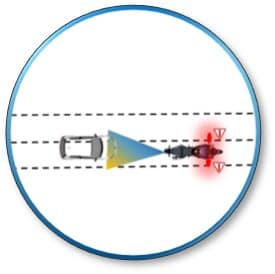
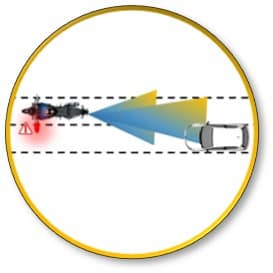
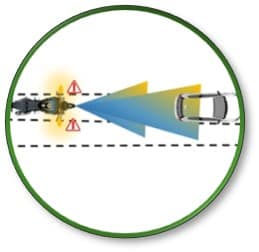
We at Edgeverse, developed India’s 1st ARAS platform with an intent to speed-up Time-To-Market for OEMs and to introduce this safety critical feature in their vehicles. With our modular platform architecture and flexible integration interface we wish to achieve integrated production ready device within 6 months. The device incorporates two 150 FoV HDR Camera Sensor, A Processing Unit capable of processing video stream at 40 fps (frames per second) and customizable alerts. The device has customizable alerts for Blind Spot, Lane Changing/Overtake, Rear and Front collision. It also incorporate features which can disable the alert system under certain heavy traffic scenarios, reducing fatigue due to constant alerts for riders. It doubles as a video capturing device with loop back recoding feature, video freeze during accident and a mobile app to pair with it for video playback, rider sensitivity settings, etc. Following are the Predictive Alert Zones incorporated in our device using Time to Collision (TTC) concept giving you those crucial extra seconds to avoid an accident.

Our vision is to make two-wheeler one of the most safest mode of transport. Please join us in our journey!!!